
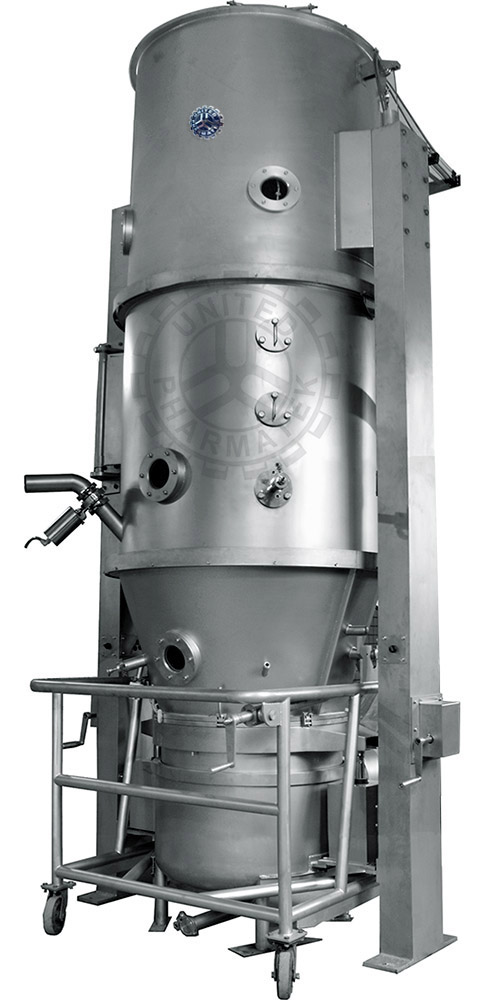
UFD Fluidized Bed Dryer
The fluid bed dryer (Fluidized Bed Dryer) is equipment used to reduce the moisture content of pharmaceutical powder and granules. The working principle of the fluidized bed dryer starts when hot air is introduced at high pressure through a perforated bed of moist solid particulates. The materials to be dried are placed in the drying bowl, which is then wheeled inside the fluid bed dryer. The wet solids are lifted from the bottom and suspended in a stream of air (fluidized state). In this state, the solids behave like a free-flowing boiling fluid.
The flow rate and the operating temperature are adjusted through the control panel. Heat transfer is accomplished by direct contact between the wet solid and hot air. The vaporized liquid is exhausted away. The drying process in fluidized bed drying reduces the drying time in comparison to using drying ovens by approximately twenty times. This is because the entire product surface area is exposed to the high-volume air stream. In addition, the fluid bed dryer provides controlled and uniform drying conditions compared to the uneven drying in trays.
Fluid Bed Dryers are commonly used for process applications, which require excellent product uniformity, particle size, moisture content and morphology. Since hot air surrounds all particles in the fluid bed, this ensures efficiency in the material drying process. There are three variables that directly affect the fluidized bed drying by the product itself: temperature, air velocity, and humidity. Sensitive particles can be damaged by high air velocities and thus require higher temperatures to compensate for the reduction in air velocity. Pharmaceutical products that are temperature sensitive can be safely processed in our fluid bed dryer by increasing the air velocity and decreasing the humidity. The inlet air temperature that is introduced to dry the wet material must be adjusted in such a way that only so much moisture evaporates from the surface of the granulate as is transported through the particles from the interior of the granulate to the surface. If the inlet air temperature is too high, a surface crust will most likely form which will hamper or even prevent the moisture from escaping the wet material, thus delaying the entire drying process rather than accelerating it.